
Redding City Directory Collections
The confirmed local directory trail begins at the Redding Library genealogy area. Public collection pages do not publish a verified local publisher and year run, and they do not verify reverse-directory years. The table names documented collections while leaving the local run open for catalog and reference-desk confirmation.
Newspapers and maps are companions, not substitutes for an inspected volume. A catalog record or digitized index can point to a person without proving a local volume for a given year.
| Collection | Years | Publisher or keeper | Where held | Access |
|---|---|---|---|---|
| Redding Library genealogy area | Collection-specific | Redding Library | Genealogy room | Bound works, periodicals, newspapers, microfilm |
| Shasta County newspaper microfilm | 1852-present | Successor papers leading to Record Searchlight | Redding Library | In-library microfilm |
| Record Searchlight in NewsBank | 1991-03-10-current | NewsBank | Library online resource | Library card access |
| Anderson Valley Post in NewsBank | 2006-05-03-current | NewsBank | Library online resource | Library card access |
| Covered Wagon | 1943-current, annual | Local-history periodical | Genealogy and local-history area | Inspect through the library |
| Boggs Local History Collection | 2,000+ items, dates vary | Redding Library | Second floor | Locked cases; many items circulate |
| FamilySearch affiliate collections | Collection-specific | FamilySearch | All three Shasta Public Libraries | Affiliate computers unlock some images |
| California Death Index | 1940-1997 | California index | Linked by the library genealogy page | Name, date, and place corroboration |
| Statewide marriage index microfiche | 1961-1981 | Statewide index | Family History Library network | Index only |
| Redding Sanborn fire-insurance maps | 1885, 1889, 1896, 1904, 1912 | Library of Congress | Digital collection | Free scans |
No verified public source supplies a local publisher, a complete year run, or reverse-directory years. A confirmed Redding city directory volume still needs a catalog record or reference-desk check. Do not turn a common Polk-style format, a nearby county volume, or a search-result hint into a local holding. Ask the reference desk to confirm each item before assigning a year to local directories.
Inside Redding's Genealogy Shelf
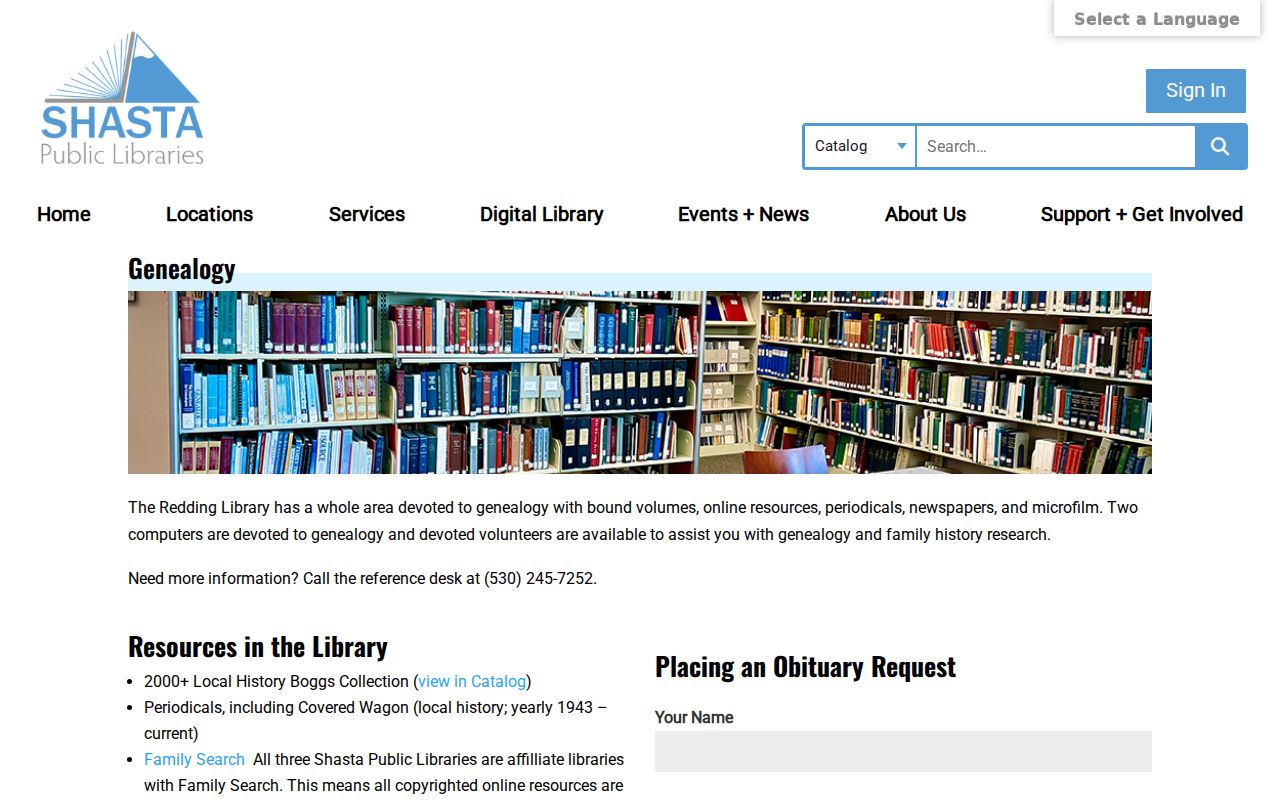
The Redding Library genealogy collection is the practical first stop. Its area has two dedicated genealogy computers, volunteer help, bound works, periodicals, newspapers, and microfilm. A call to (530) 245-7252 can settle whether a catalog item is a local directory, a related phone book, or another local-history source.
The genealogy page connects the shelf with an obituary request form, the California Death Index, NewsBank, and FamilySearch. A library card opens NewsBank material, while affiliate computers at Shasta Public Libraries can show restricted FamilySearch images unavailable from home.
The Redding Library genealogy page is the source for the view below. It is not a verified scan of a local directory volume.
Before traveling, give the reference desk a surname, approximate period, and need, such as a name list, street section, obituary, or map. That keeps the year gap visible.
Newspapers Between Redding Directory Years
Shasta newspaper microfilm runs from 1852 to the present through predecessor papers that eventually merged into the Redding Record Searchlight. That long run can bridge a missing directory year with a sale notice, social item, address, death notice, or community event. Search names in more than one spelling, especially when an old entry uses initials or a married surname.
NewsBank adds full-text Record Searchlight coverage from March 10, 1991 to current and Anderson Valley Post coverage from May 3, 2006 to current. The annual Covered Wagon, available from 1943 to current, adds local-history writing and names that may not surface in a government index. These sources help date a move or disappearance, but a newspaper statement still needs context from the city directory, census, deed, or obituary record.
Note: Newspaper microfilm can supply the event date needed for an obituary request when a city directory only shows a last known address.
The Boggs Story in Redding
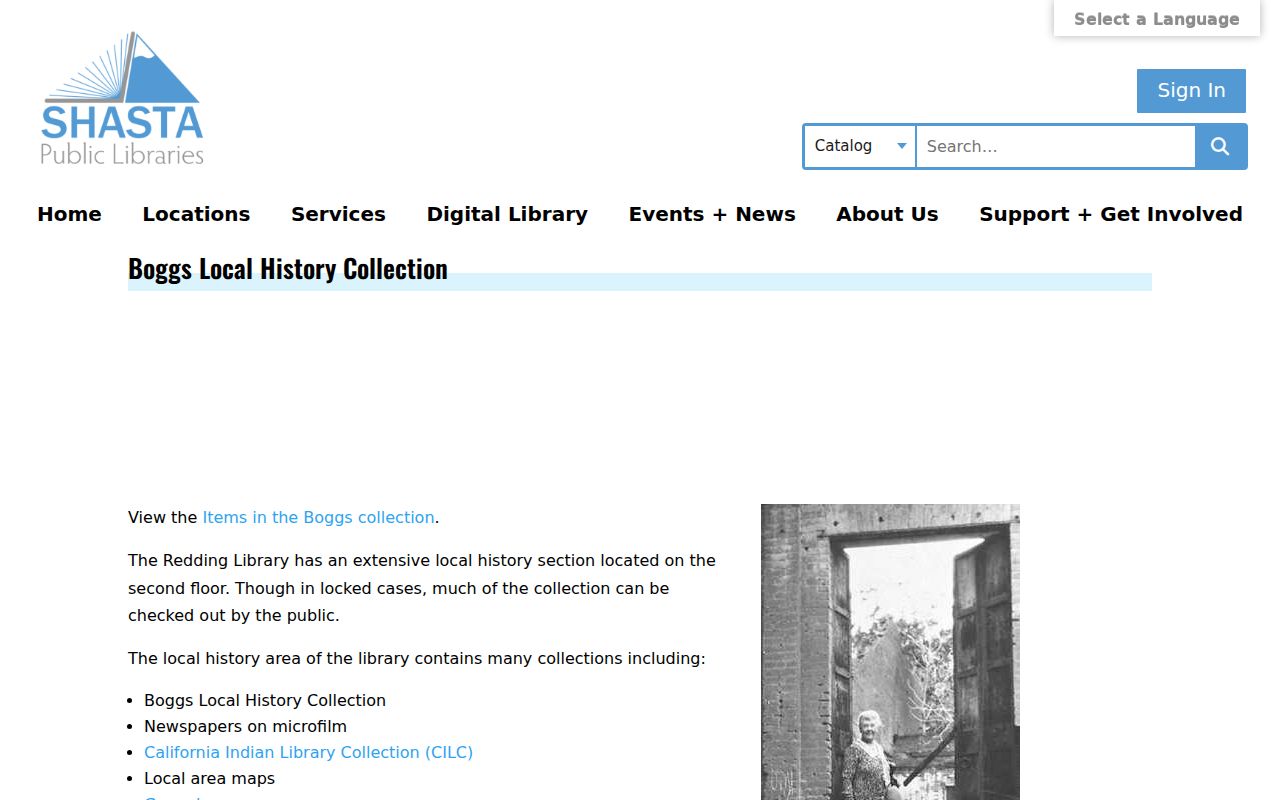
The Boggs Local History Collection adds a memory layer around the local directory shelf. It exceeds 2,000 items and includes maps, local history, and California Indian Library Collection resources. Much is in locked cases, while many items circulate.
Mae Helene Bacon Boggs donated the nucleus of the collection and its antique bookcase. That story gives family history a human starting point. A name may connect to a neighborhood, institution, map, or event even when no year is confirmed. Treat the context as a lead, not proof of an address.
The Boggs collection page is the source for the local-history setting shown here.
Pair an item with its date, title, and catalog description, then compare names with newspaper microfilm or a known directory entry. That can turn a name clue into a documented story without making every item a resident roll.
Reading a Redding City Directory Entry
No openly digitized local volume was available for a verified Redding sample entry during research. The inventory below describes fields to inspect in a typical Polk-style volume, not a locally verified example. Copy the title page and abbreviation key before reading marks as facts.
| Name | Surname, given name or initial, spouse in parentheses, and widow notation when present. |
|---|---|
| Occupation or trade | The listed trade and employer when the volume supplies them. |
| Residence | House number and street, often with a short mark such as “r” for residence or “b” for boards. |
| Business address | A separate location when the entry gives both home and business places. |
| Owner or renter mark | A symbol or abbreviation if that volume uses one. |
- Criss-cross directory
- A reverse section arranged by street and house number, with the occupant listed after the address.
- Householder index
- A name-to-address finding aid centered on a household head or primary entry.
- Abbreviation key
- The volume's short-form guide, used to interpret marks such as residence, boarding, widow, or owner status.
An entry can show a useful relationship without proving the whole household. Compare occupation, spouse notation, address, and owner marks across years, but use the underlying volume and an independent record.
Redding's Archive Fallbacks
The Shasta Historical Society at 1449 Market Street in Redding is a local fallback. The library identifies its phone as (530) 243-3720 and points researchers to Collections, Research, Search Collections, and appointment pages. Ask about photographs, family files, vertical files, manuscripts, and directory holdings, then confirm services and fees before assuming an item is available.
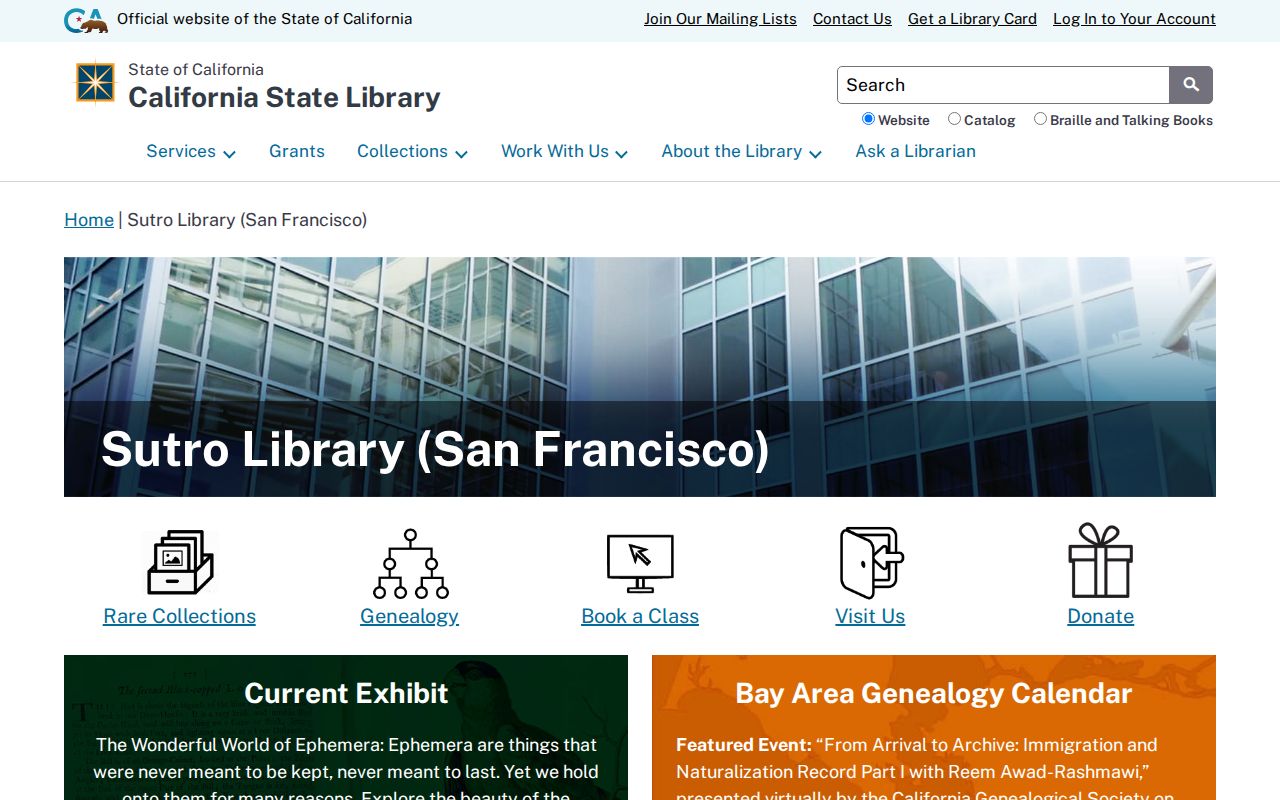
For material absent from the local shelf, the California State Archives is a gateway to state government and selected county historical records, older indexes, and naturalization material. The State Library's California History Room and Sutro Library add newspapers, directories, maps, manuscripts, and genealogy collections. These are fallback channels, not proof that a missing local year exists.
The Sutro Library page is the source for the statewide genealogy fallback shown below.
When a search stops, carry the exact title, date range, publisher if printed, and catalog wording to the archive desk. A precise request beats asking for every directory connected to Redding.
Note: An archive catalog can describe a collection without confirming a complete local directory run or public digital images.
Using Redding Directories for Family History
Start with the nearest known year, if a local volume is confirmed. Copy the city directory entry, record its title-page details, and follow the surname one volume at a time. Note spelling, initials, spouse, occupation, address, and owner or renter marks. If a reverse section exists, read it by street and number to find nearby names.
- Choose the volume nearest a known event and write down its date, title, and page context.
- Compare adjacent confirmed volumes, keeping name variants and address changes separate.
- Use the criss-cross section, when present, to test the house number and nearby occupants.
- Pair directory entries with the 1940 and 1950 federal census schedules. The 72-year rule makes 1950 the newest public population schedule; 1960 is scheduled for 2032.
- Close a gap with newspaper, obituary, probate, deed, or cemetery evidence, and label each source by date and role.
A missing name may reflect a move, death, remarriage, omission, missing volume, or spelling change. Obituaries can date a disappearance, deeds can show ownership, and census schedules can show household composition. None replaces an unverified year.
Redding Directory Obituary Trail
The Redding Library obituary request is a direct fallback when a directory entry ends without an explanation. The form asks for the requester's name, phone or email, the subject's name or event, and the death or event date in Shasta County. It includes a mailed-copy option and a paper-check method. Those fields make a narrow date window more useful than a broad request for every mention of a surname.
Use the last known address to set a search window, then check the 1852-present newspaper microfilm and NewsBank. An obituary may name survivors, a service date, or a prior community, while probate notices can add heir relationships. Compare those details with the directory and census, not a current address assumption.
For difficult items, carry the date and spelling to the library, Historical Society, Archives, or Sutro. A dated newspaper notice plus a confirmed entry is often strongest.
Redding City Directory Maps and Address Clues
Sanborn fire-insurance maps help explain what a directory address meant at the time. The Library of Congress Sanborn collection has Redding editions from 1885, 1889, 1896, 1904, and 1912. The sheets show a building footprint, use, material, and street-number context. They do not identify occupants, so pair a map with the volume, census, deed, or newspaper.
Redding's place history also matters. The 1872 townsite lay between North, now Eureka Way, South, East, and West Streets, and the city incorporated in 1887. Buckeye joined much of Redding in 1969; 1976 annexations added areas south and east. An older directory may use a community or street description that does not match a current search box.
When connecting a historical address to a present parcel, compare the legal description, subdivision, map, and deed, not just the street string. No official dated Redding renumbering or ZIP-realignment history was found, so preserve uncertainty.
Note: A Sanborn sheet can settle building context, but only a name-bearing source can connect that structure to a household.
Redding Directory Limits and Next Steps
A Redding city directory is a historical clue set, not a complete list of everyone in the city. It may omit children, renters, boarders, protected people, or anyone absent from the volume. A name can disappear because a person moved, died, changed names, used initials, or fell between unverified years. Keep the source date and role shown.
For a modern identity question, a natural next step is a Redding resident lookup that compares official records without treating a directory entry as proof by itself. For family history, keep the chain narrow: confirmed volume, newspaper date, obituary request, census schedule, deed or probate record, then archive follow-up.
Use the reference desk at (530) 245-7252 to verify local and reverse-directory years before citing them. Respect sealed records, protected addresses, and the distinction between occupant, owner, mailing recipient, and historical name.